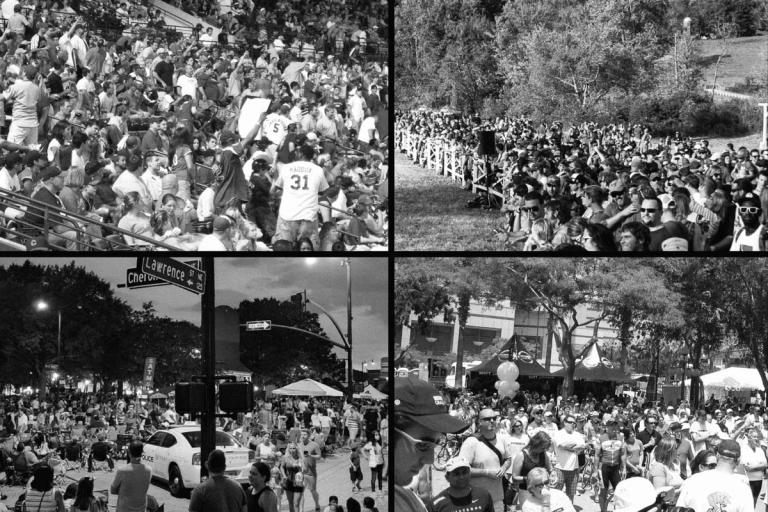
Who rides? Everyone! Who buys? Everyone! Who are we missing? Almost everyone!!! Do we have an identity crisis? No… but a better question would be: Are we identifying with & offering products and services to those who (might) ride & buy within our communities? After that, we need to ask ourselves: Do we even want to? You might be surprised by my observations surrounding consumer-inclusivity in our industry. Regardless of anyone’s opinion, this is a great conversation that too often ends prematurely with shoulder shrugs because we keep supporting a single ideal that no longer works in its current form.
Let’s start at the bottom. Take a quick look at the collage of photos that I dug out of the dark depths of my old photo albums. The last baseball game I attended (almost 20 years ago), a Red Bull dirt jump event, my local town square, and a charity ride that I sponsored. I am willing to bet that 99% of the people in these photos have ridden a bike. I am also willing to bet that over 75% of them won’t set foot in a bicycle shop more than once a year… if ever. Are we really okay with that? Let’s discuss what inclusivity is, whether we want it or not, and how it can affect the ways we do business in our communities. * (While this is consumer-focused, I definitely want to get input & discuss the industry’s position surrounding internal inclusivity, in a number of future pieces).
The word inclusive gets thrown around a lot these days. When it comes to basic human rights & well-being, it should be a no-brainer that we strive to achieve and improve it. However, (and you’ll hear me say this a lot), we need to approach some things with a ‘plural set of beliefs’ when it comes to how we do business. Look at it this way, it’s possible to believe in multiple ways to run our business, but choose to do one and not the others. That’s being ‘exclusive’. Of course, a lot of planning & weighing compromises come into play, but in short… not every shop & supplier can serve everyone all the time. That’s what department stores strive to do. BUT as a whole, the Bicycle Industry can do WAY WAY BETTER at being more inclusive.
Buckle up…
Why do we all look alike?
Six years ago, I wrote an opinion piece in Bicycle Retailer & Industry News titled, The Bike Industry Doesn’t Really Exist. It basically ended saying that we should instead consider ourselves an ‘IBD Industry’ (IBD, Specialty Bicycle Retailer, tomato, toMAAto), because the traditions that have both helped & hurt our efforts to succeed, need to be updated & refocused (it’s too bad BRAIN took comments off the site as there were some great things being brought up). There were some other scathing opinions on how I felt (still feel) about branding & growing a business in today’s marketplace, but the key message reinforces the discussion I want to get started here.
I think it’s fine to cater to the kinds of customers we associate with, but why the hell do all of us do it??? Sure, there are ‘varieties’ of shops that may lean more towards a particular segment (road, mtb, boutique, family etc.), but that’s not what I’m talking about. Even the most family-oriented shops fall into what most of us call a ‘Specialty’ bicycle retailer. Even if a shop doesn’t sell a single carbon product, they still don’t carry things that the majority of their POTENTIAL customers align with. *(Margins & Cost/SqFt have entered the chat)* Think about it… the majority of us order from the same suppliers, and those who work in customer-facing positions usually cherish & are a part of all that is Bicycle Culture. Then you consider the overwhelming majority of bikes sold have never been from a modern-day bike shop. Heck, let’s consider what the highest volume of bikes we sell are (bread & butter bikes). Do we even cater enough to those cultures?
I know it’s asking a lot to consider hiring someone who, at most, may only occasionally ride a comfort eBike, working in what most of us consider the average shop… but that’s because we’re 100% accustomed to bike shop culture centering on enthusiasts like ourselves rather than what they sell the most of. Sure, being polite, helpful, & experienced may sell bikes, but does anyone really believe that our bread & butter customers identify with us the same as those already drinking the gel packs?
While those bread & butter customers may not need to get high on bikes like the rest of us, wouldn’t it be relaxing & unintimidating to walk into a store with boring bikes and the plain ol’ average people to match? Bread & butter customers probably feel as out of place as we would trying to converse with someone selling us a bike with the backwards fork at our local department store. Many of us will rightfully say that we are very customer-oriented when it comes to servicing each & every person. THAT’S GREAT… so as long as you are good with only selling bikes to people who get past the intimidation factor or misguided assumptions on whether a ‘Specialty Bike Shop’ is the right place for them.
I am not hating on ‘Specialty’ bike shops… I’m asking, WHERE ARE ALL OF THE NON-SPECIALITY BIKE SHOPS AT???
Category Gap > Price Gap – Where’s all of the Non-specialty bike shops?
I’ve been wrong about something for far too long (go ahead… add it to the list). I used to think that we needed a solution that centered on providing quality & affordable bikes that bridge the price gap between department store & bike shop bikes. I don’t think that’s necessarily a bad thing, but now I think it’s only a small part of the solution. You would not be wrong to assume I am throwing a pile of shit against the side of a barn to see what sticks, but it’s basic ‘Business 101’ to make sure the products you’re selling align with your business model. While WE define a ‘Specialty Bike Shop’ as something that sells ‘quality’ bicycles, consumers don’t… or at least, don’t want to. If a roadie prefers a shop with other roadies that caters to roadies and a dirtbag like me digs a shop that centers on supplying & fixing the shit we break… I’ll give you one guess as to what a bread & butter customer in the market for a comfort or budget-friendly bike prefers.
A non-speciality bike shop could open some doors that the current traditional shops haven’t been able to. For instance, the demand for a ‘price gap bike’ category has been an unattainable fantasy for years. Even the most family-oriented shop can’t justify the margin dollar-to-cost/sq ft ratio, and they don’t want to take the risk believing that it will attract those who have never stepped foot in their door. However, if there were a shop that only sold non-enthusiast/bread & butter bikes, it would be much easier to add a category of bike that was priced somewhere between a department store & specialty bike shop bike. This would also allow specialty bike shops to narrow their inventory range to that which better aligns with their culture.
A non-speciality shop could also fit in some non-traditional categories revolving around things like the exploding micromobility market, commuters, and other things that align with their non-enthusiast community. The people working there might be less likely to ooze that SUPER BIKE EXPERT with *insert cliche shop employee trait* that Bike Cult non-members view us as.
Super Specialty Shops & RAD non-boring brands!!!
Yall probably thought I was going to leave all the cool kids out. I have mumbled thousands of times “I hate these bikes” when unboxing a 45-pound comfort bike, complete with suspension seatpost. Despite taking less time to build that a higher-end bike, it bruised my soul each time I looked at that sprung cushy saddle and adjustable stem. I didn’t work in bike shops because of those bikes. Comfort, hybrid, and even youth bikes diluted the space that our shop culture was based on. Sure they made money, but they also required us to have a lot more floor space and people to sale, assemble & work on them.
And before we all say what we’re all thinking (that we don’t sell enough mid to high-end bikes to be profitable), in addition to not needing as much floor space or people (some would work for a non-speciality shop, so I think overall, more people will have jobs, not less), when you have a non-specialty store that sells bread & butter and ‘price-gap’ bikes, suddenly have a whole new category of rider being added to ‘ridership’. Currently, consumers only have a Good & Best when it comes to buying bikes. Could adding a non-specialty shop to the mix be the ‘Better’ we’ve all been waiting for? It’s no secret, increasing ridership increases business, so if it actually works out, that enthusiast/speciality bike shop might do better, become more sustainable, and be way cooler to shop & work at.
Could the OEM market support cooler specs?
I came across this article written & posted on LinkedIn by Craig Hoyt the other day, and it made some great points on how brands have streamlined their bike-spec offerings to the point of being boring. His article hit the nail on the head when it comes to being something most of us can probably relate to. Those of us who were around in the late 80s to mid-90s remember when many of the upper to high-end bikes were often spec’d similar to today’s frame-up custom builds.
I attribute much of today’s sleep-inducing specs to suppliers grasping onto the value of having a ‘one-stop-shop’ for OEM accounts. This drove suppliers to fill the missing pieces by either purchasing multiple brands under their umbrella or resourcing/developing their own in-house parts to spec. *YAAAWN* Another driver had to do with the exploding number of brands & bike categories, forcing companies to streamline (simplify) the OEM market. Back in the day, it was WAY EASIER for companies to play with specs because there was only a fraction of the number of bike brands & categories compared to today. Today, there are probably twice the number of mountain categories alone than there were total bike categories 25 years ago. On the flip side, there has also been a massive increase in the number of boutique parts & accessories brands that may have been driven by people trying to get away from those boring specs. Even the number of custom frame builders ‘brazed’ a trail unlike anything we’ve ever seen over the last 20 years.
But this all begs the question… If some retailers focused more on the mid-to high-end consumer by letting someone else focus on the boring budget and bread & butter ones, would suppliers be able to offer more flexible spec options? Kind of like back in the day when you or the consumer could choose between a few different groupos or build kits. While this sounds more like a ‘custom build’ because it wouldn’t be ‘OEM spec’, back in the day when we had those ready-to-ship build options that allowed shops to build bikes that were priced (and spec’d) nicely between a stock & full custom built bike… plus they included our favorite LABOR CHARGES! How would the margin look on something that only costs a little more than stock, when you get to add in labor (vs nothing for assembly)?
Could this be more sustainable than the current way we do things?
Let’s reconsider the facts mentioned earlier:
- The mass majority of bikes sold don’t come from bike shops
- Bread & butter bikes don’t match our average shop culture
- Despite the demand… that massive department store/IBD price gap still exists because there isn’t currently a place for that budget category of bike to live.
Speaking of labor charges & *cough* Mechanic’s Pay
While I have only discussed culture & products in this piece, there are a lot of peripheral things to consider as well. Just like in the auto industry, there is a broad range of labor & service fees and *cough* technician pay because no one is going to pay $300/hour to have a Ferrari tech change the oil on the family truckster. In our current retail model, we generally charge the same labor rates, forcing us to pay mechanics a median wage that justifies them working on both shitty bikes & custom builds. I’m just speculating, but in a boring bread & butter shop, I imagine that’s where all of the new & temporary mechanics would live, making a lower wage. Career mechanics, who focus on continuous training, wouldn’t compete with the non-career mechanics taking up space in the mid to high-end market, and likely be paid based on their qualifications because the shop could justify charging higher labor rates.
Are we about to repeat the same mistake?
Is a concept like this something our industry could support… or is this something we don’t even want to consider and are fine with outsiders from the eScooter & OneWheel market (poorly) taking advantage of? Ten years ago, I listened to dealers & suppliers alike swear off eBikes, then later complain about specialty bike brands selling them to the powersports and other non-traditional channels. Are we missing another opportunity because we refuse to align with products (A LOT of) people want?
We’re already seeing non-enthusiasts pushing these products on the eBike side of things (often in a poor way with little to no QC or follow-up service), but if a current business model in our industry is struggling and is already 100% equipped to sell & maintain a segment in high demand, are we taking the time to measure it as a viable option? While an assumptive side thought, a non-specialty shop with experienced people could bring better quality control to that market while reduding the demand for the really bad cheap junk making it way here.
In closing…
We’ve seen some retailers lean towards the high-end side of things, but what if a small percentage of full-line shops began to lean towards being more budget-friendly to better identify with that massive… and POTENTIAL group of consumers? Rather than having three shops in the same area competing for the same consumer, how would things look (things being RIDERSHIP) if each of those shops became more specific, with one only dealing in budget and bread & butter bikes (along with booming categories like micromobility products)?
I don’t know if any of this works or what the magic formula is, but there are not many examples of places selling botique kobe steaks next to Salisbury steak TV dinners (the Night Hawk Steak & Tators was my personal jam). I am curious if suppliers & bike shops would become more sustainable for the long-term if we re-dialed our culture & products so that they align with our current & POTENTIAL consumers… but not in a half-ass way (sorry, I cringe every time I hear someone suggest a different version of something we’ve tried a 1,000 times because it’s easy or all they understand). Of course, all of this is subjective as there would be a ton of gray area due to an endless number of factors, unique to each situation.
I’m not trying to be a dick. I’m asking some questions that each of us should have justifiable & honest answers to when considering whether or not our current business model still works.