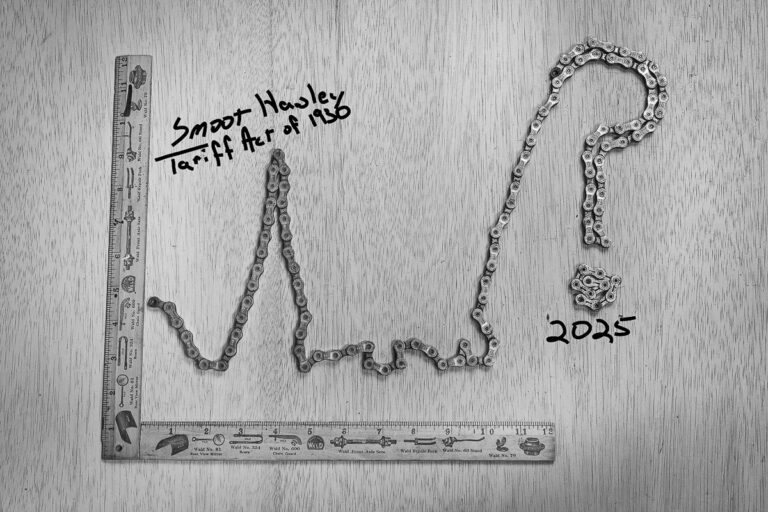
As I scramble to finalize & launch this project that centers on strengthening the Bicycle Industry’s (sustainable) health through communication & overdue discussions, nothing could have prepared me (or any of us), for this. My key subject matter went from seeking solutions based on shifts to ‘oh shits’ in the marketplace practically overnight. But are these abrupt tariffs & economic shifts anything new? To most alive today, this seems like something that’s never happened before as we typically focus on what we have experienced or heard others talk about. Even the Great Depression is just something we grazed over in school, but you might be surprised to know what’s happening now, happened then. Fear, blame, distractions, and even a false villain.
Despite loathing history in school, I stumbled into & have been trapped in the study of the Industrial Revolution for years, focusing mostly on tool making and the global evolution of all that is bicycle. The patent wars, unethical judgments, and corporate takeovers between the mid-19th & early 20th centuries would make our current president blush. Skipping to the present, I see much of what is happening right now as us repeating history more so than some brazen move. Even if you know how tariffs work, it doesn’t mean you’re right about the results, good or bad. Too often, we as humans refuse to admit to ourselves that our bandwidth is extremely limited. Knowing ‘just enough’ does not mean we’re right. Something I have tried to teach my kids is to not let their perspective form a perception unless they are in fact, an expert on the matter. Basically, rather than trust your opinion, leave some room for interpretation and consideration. The best leaders understand it’s impossible to know enough about everything under their umbrella, so instead, they base decisions on experts they trust.
Who’s really at fault?
I don’t care what side one person vs another is on. Deep down I am all but certain that most of us want close to the same thing in the end. Many today see the US economy & trade being crippled by other countries and I’d like to officially state, that I think that is true… but do we agree as to why? We often blame other countries for making cheap stuff and ruining the manufacturing culture we lost decades ago. On the surface that is what many accept as the cause, but I have yet to hear many talk about why or who’s responsible. I’ve been to China & Taiwan factories & tradeshows and have placed orders for tires & tubes for both the best of the best bicycles as well as those you find on department store bikes. I can assure you, rarely is a single item coming to the US from a factory in another country a piece of shit because of anything the factory chose or did. It’s almost ALWAYS because of what someone or a group of people HERE decided is most important (does anyone want to guess?). There’s nothing wrong with capitalism, but we need to understand the differences between a toxic & healthy version of capitalism.
*For more on how things shifted, it’s important to note China’s economic shifts with post Mao’istic trade policies which later led them to be welcomed by the World Trade Organization and gain ‘Most Favored Nation’ Status.
I blame two key factors that led us to where we are:
– Influence from President Nixon & other opportunists to increase trade with China following their own trade reform.
– The ‘non-working class’.
The non-working class
I bring up the non-working class in conversations, often confusing people. I define a non-working class… including many here, (lemme explain), as those who have influence over a company they don’t work for, or have any part in their operations. Stockholders & shareholders. In the Bicycle Industry, we have seen many times & very recently, when a great company with great products shutters its doors, even days after announcing new models. This situation almost always has to do with non-bicycle industry investors looking at nothing but the current risks & uncertain futures and weighing them against less risky ones. Don’t get me wrong, seeking capital investors is one of the best ways to grow a business to be (more) competitive, so as long as things work out. There are always several unique things at play when things don’t work out but the big ones are, over-hyped forecasting, lack of knowledge about the Bicycle Industry, and simply bad timing (the one-two punch of the pandammit & tariff sheriff coming to town is something few could prepare for). During hard times, independent companies can more easily make internal decisions on how to proceed based on industry knowledge, often with employee retention in mind (company leaders almost always consider their employees’ well-being regardless of what’s safer). When investors come into play, hard times can result in anything from demands to reduce payroll, all the way to turning off the lights, instantly. Investors’ only responsibility is the bottom line. Of course, there are often clauses that include severance packages and whatnot, but in the end, we have to ask is it worth it.
Back to the big picture. In the 1970s, it was in fact a team effort between this ‘non-working’ class & politicians to put US workers in competition with those overseas because it was easy, risk-free money for the decision-makers while leaving American workers to deal with it, (and of course, be directly affected by it). While regular folks (us) who make up 99% of the US population, may dabble in the stock market or investments, we don’t affect the market individually. However together, along with the massive institutions that handle our assets which just so happen to be run/managed/regulated by the top 1% (who literally make a living playing with the US economy like a Monopoly board), determine the direction of practically everything associated with our economy. Not only do they control the shifts in the marketplace affecting everything from job security to pay, most of the wealth society produces for them never gets re-circulated back into the economy it came from, causing it to become even more vulnerable… dependent? Everything from education, medical care, and banking, (plus other basic things practically everyone needs to sustain a basic or progressive lifestyle) has been monetized to the point where those same people who control the economy, control us rather than us controlling the economy (the basic fundamentals of democracy).
Imagine if instead of tariffs, our leadership put an equal restriction on stockholders & outside investors… and weren’t allowed to buy in or accept ‘funds’ from large corporations. What if a company’s success was more organic, depending on internal decisions being made about producing good & affordable products? Post WWII through the early 70s, we did just that and key small businesses like family-run grocery stores could be supported by their local economy. Bike shops have held their own, but many of the reasons it’s remained so hard to keep doing it. The gap between minimal wages and the minimal cost of living on top of unlimited access to building inescapable debt created a government-controlled economy & population.
So why aren’t we electing less corrupt people? Politicians like Jerry Brown didn’t stand a chance on the national stage because their ethics prevented them from doing so. When the rich want to get richer, they’re not about to let anyone get in the way of that. While serving in various elected roles in California, Brown turned down perks he was entitled to (like when he paid for his own $275/mo apartment while serving as California’s Governor… and driving a basic 1974 Plymouth). When Brown ran for President in 1992, he would only accept a maximum campaign donation of $100 from individual people. No corporations or anyone with a financial interest could buy him… so they practically made him out to be weird & unstable. The multi-million dollar campaigns focused on smearing every chance he had of getting elected. And before I get accused of taking sides (I hate both), like most, I believe I want the same thing as you. My hope in writing this is that we consider, despite what we may hear, that there is more at play than any of us… including myself, can even begin to fully understand. I feel the general population is being steered (distracted) towards the results rather than the cause, hence why we’re still chasing our tails. The biggest not-so-secret weapon being used is convincing an oppressed population they’re not oppressed and fabricating a villain to distract them from the truth. Hate, misguided or not, will lead someone to fight all the way to poverty because someone they trust told them to. Trust too often outweighs facts because it’s one of the core values that brings us together.
Tariffs
Look up the Smoot-Hawley Tariff Act (1930-1934). Even during a time when the US was well-established as a manufacturing economy, we still heavily relied on trade. Like today, we have always been part of a global economy and more so when we used each other as allies during times of war. The US was never self-sufficient in the way many over-generalize it to have been, and think it should be today. The Smoot-Hawley Tariff Act of 1930 was the result of a president listing to investors and ignoring the warnings from economists… who even staged protests hoping to gain the public’s support (who here really thinks rich investors are looking out for us more so than formal experts on the economy?). Oh, this was right as the Great Depression (1929 – 1939) was just getting started. The Smoot-Hawley Tariff Act not only did the opposite of what was promised, it made those who supported it very rich because they prepared and were (literally) banking on it. To most, (non-economists), it seemed to make sense because someone was being blamed and we were doing something that sounded like a solution that benefited us while hurting them.
During the Great Depression, like today, it can be to someone’s advantage if they establish a villain because humans desire someone to blame when things are bad. The Smoot-Hawley Tariff Act was a staged retaliation against a false villain while distracting people from the real issue, just so a few could benefit by taking advantage of a desperate economy.
The Bicycle Industry and Tariffs
Tariffs Round 1 – 1930
As the Smoot-Hawley Act went into effect, the Great Depression had already affected the economy, and like most things, the demand & availability of bicycles were likely affected. Many of the parts for bicycles were already coming from overseas so the new Tariff Act probably crippled bicycle companies because they couldn’t sell bikes with missing components (sound familiar?). Without going too far off the path, one of the reasons bike companies needed to purchase components (like tires), was because many of the manufacturers here who had supplied bicycle companies in the past shifted resources to support the booming auto industry. Some bicycle companies had ownership (or probably exclusivity) of some of the harder-to-get items still being made here, leaving the rest to source elsewhere. In Europe, due to their infrastructure, the automobile craze wasn’t as abrupt and the demand for bicycles remained strong. It made more sense for them to continue producing things that would benefit them domestically… and even better, that they could export to the US.
Medium to small (and several big) companies relied on both domestic & global trade, hence why distribution companies came about and grew to support manufacturers & retailers alike. When the Smoot-Hawley Act was being presented, it was made out to sound like a win/win situation because it was presented in the most simple way… to upset people. It did this, all while leaving out all of the real-world details of what would really happen. When the entire nation was in the middle of the Great Depression, this blame tactic got a massive amount of traction, and not even the accumulation of formally educated economists could convince the population (and Hoover) otherwise. Sound familiar?
There has always been a symbiotic relationship that kept both the US & its global partners economically healthy. As soon as it was interrupted, all countries involved were negatively affected. The appearance of an independent US economy was quickly proven to not exist much less be possible. So what about today? What happened to our manufacturing & dependence on domestic goods and are these new tariffs any different?
Tariffs Round 2 – 2025
So why now? Why are massive tariffs being tossed back into the US’s global trade game? Well, if we jump back to the 3rd & 4th paragraphs above about how trade shifted thanks to the non-working class & China’s overly welcomed trade & later induction into the WTO, then consider how Round 1 above played out. I can’t help but think that we are being presented with another (false) villain and with what appears to be a simple solution, that isn’t going to work like some trust it will. Yes, we need more manufacturing here, but are tariffs and imports the real problem? Tariffs are being presented as an almost quick fix, but I personally can’t fathom how they will fix anything in the long or short term. The math just isn’t there.
Consider this: Bike shops, suppliers, and manufacturers use several resources from within our own domestic borders. Imagine what would happen if shops in Texas were not allowed to buy out of state and were told they would have to figure out how to make products and supply themselves with everything they needed. Let’s go all the way to fantasy land and say that they had two years to prepare before it went into effect. Would they be able to organize, build, and start production in that amount of time? Even if they could, they would have to figure out how to do it while keeping prices affordable. Paying for the infrastructure and DOMESTIC labor alone would cause an unreasonable increase in operational costs that nets a product nobody could afford. The result two years later would probably look something like a mishmash of a used bike market with no new bikes (with new parts) to be seen. Five to 10 years down the road, there might be someone making super crappy bikes and some really high-end ones that cost way more than they do now. The price gap between low-end and a ‘shop level’ bike would be more astronomical than it is now. Add to that, the bikes made in Texas would be inferior and more expensive than those across the nation. A single state operating without a network of national partnerships, who work TOGETHER on a massive scale sharing resources, would continuously fall behind in every direction, much less keep up (or surpass) the other 98% of the country. I imagine ridership would likely become non-existent there because expecting consumers to buy crappier bikes that cost more is unreasonable. Essentially, cycling as we know it would practically disappear in that state. That’s what I fear will happen to the US with practically everything (not just bicycles) if we shut ourselves out of the global marketplace & trade.
From my super-unqualified perspective, it will be virtually impossible for us to bring back a sustainable level of manufacturing to the US until we restrict how easy it is for the non-working class to profit off those with their feet on the ground (practically all US workers), and put our foot down on unethical foreign trade. Just so I don’t appear to over-exaggerate, something like this would probably take a generation’s worth of time as not only is the US short on manufacturing facilities & supplies, we’re extremely short on the technology, the number of qualified humans, and affordable education & training programs that lead to decent paying jobs. One of the biggest barriers is that nothing would be possible until we narrow the gap between a living wage and the minimum cost of living because there is no math in existence that supports the US’s ability to afford domestically made products under current conditions.
Two things come to mind:
– If more manufacturers & distributors in the US are motivated to (and could easily) import what they need to complete products made and/or assembled here, (over importing finished products), perhaps we would see a shift towards rebuilding our manufacturing infrastructure.
– We need to be able to pay a living wage while making products affordable at the same time…which that same non-working class (currently) controls. What’s the point of making things we can’t afford?
– *Bonus: Fuck every politician and billionaire who gets rich in any unethical way or form, while preventing their money from being circulated throughout the economy they feed on.
Final Thoughts
I tossed this together after chatting with a handful of industry friends directly affected by the latest & potential tariffs and observing various views of those in and outside of our industry. I don’t claim to be an expert but I can relate to the misconceptions many have because unless you’ve been on the supply side of things and worked with factories & OEM partners, it’s virtually impossible to understand all of the little moving parts involved in making a bicycle. Without having had 1st hand experience with foreign trade, tariffs, and an endless number of regulations, I can’t honestly say what my position would be on this.
Every manufacturer has suppliers they need for certain components and raw materials and rarely are they locally acquired. I grew up in the dead center of blue-collar country, 10 minutes from the US’s largest refinery, and it’s shocking how many raw materials even refineries import. (look up sweet & sour crude in the US if you think drill baby drill is the answer). There are countless items & processes unique to each manufacturing process, how products are categorized & permitted/held, and what it takes to finally make it to the end consumer. Assuming tariffs are the answer because they’ll bring the cost of imports close to that of domestic-made goods sounds logical until you consider the real-world requirements & outcomes.
One of my hopes (I refuse to say prediction because I don’t think anything is predictable at this point), is that like the Smoot-Hawley Tariff Act, those at the top who supported the tariffs will get what they wanted right before it gets shut down after the masses (including most of that ‘not-working class’, who are already super pissed), admit what a huge mistake they are. Greed & leadership often walk hand in hand and the history of using fear to drive an agenda is nothing new, or (hopefully) lasting.